

In the last article we learnt that neurone cell-surface membranes are polarised at rest (when they are not being stimulated). However, when a stimulus is detected, a nerve impulse must be transmitted along the neurone. Today we will look at the sequence of events that happens during an action potential and how ion channels bring about the changes.
Changes in membrane potential during an action potential
This graph will become very familiar to you if you are studying A-Level biology. It shows how the potential difference across the neurone membrane changes during an action potential. The membrane potential begins at -70mV (resting potential), then climbs to -55mV after a stimulus arrives. This is the threshold level – a full action potential will only be triggered if the membrane potential reaches -55mV. If threshold is reached, the membrane depolarises and the potential difference reaches about +30mV. Next, the membrane repolarises and slightly overshoots resting potential to reach -90mV. This is called hyperpolarisation. Eventually, the membrane potential returns to -70mV (resting potential).

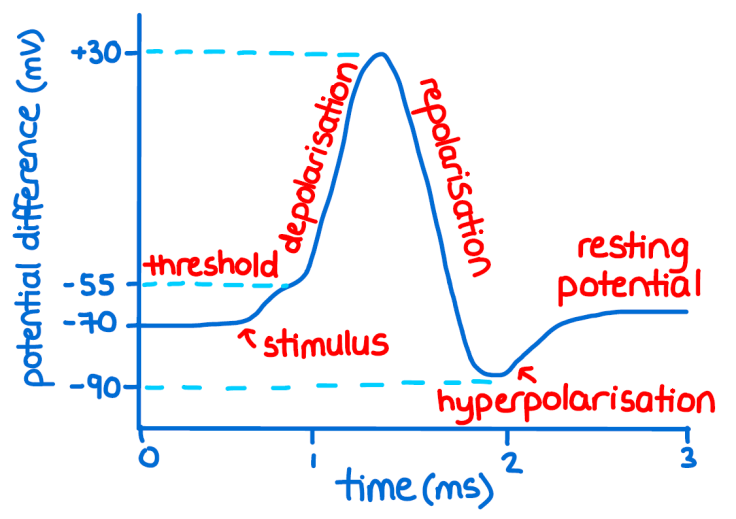
All of these changes in potential difference are brought about by the opening and closing of ion channels.
Ion channels during an action potential
We saw on the graph that there are four main stages to an action potential: depolarisation, repolarisation, hyperpolarisation, and the return to resting potential. Voltage-gated ion channels (ion channel proteins that only open at a certain potential difference) are needed for these processes. Note that the potassium (K+) ion channels that were open during resting potential are not voltage-gated and remain open.
- Depolarisation – when a particular section of the membrane reaches threshold (perhaps due to sideways diffusion of sodium ions – see next article), voltage-gated Na+ ion channels open and the membrane is more permeable to sodium (Na+) ions. They diffuse into the neurone down the electrochemical gradient that was set up during resting potential. The membrane depolarises and the potential difference reaches about +30mV.

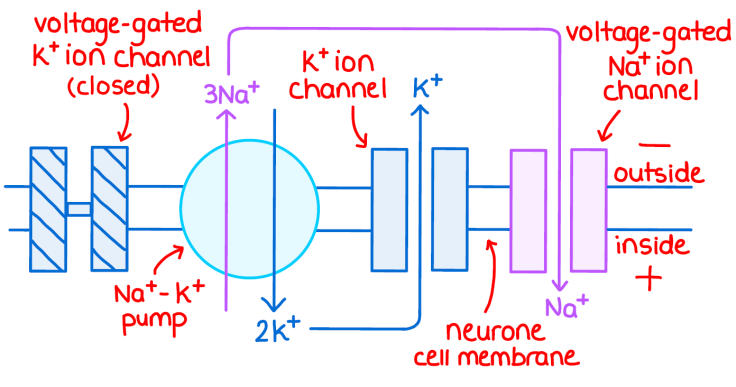
- Repolarisation – at +30mV the voltage-gated K+ ion channels open so the membrane is more permeable to K+ ions. The K+ ions diffuse out of the neurone down an electrochemical gradient and the potential difference comes back down. The voltage-gated Na+ ion channels are closed and inactivated.
- Hyperpolarisation – the voltage-gated K+ ion channels are slow to close, so there is an overshoot to -90mV while too many K+ ions diffuse out of the neurone through the open channels.

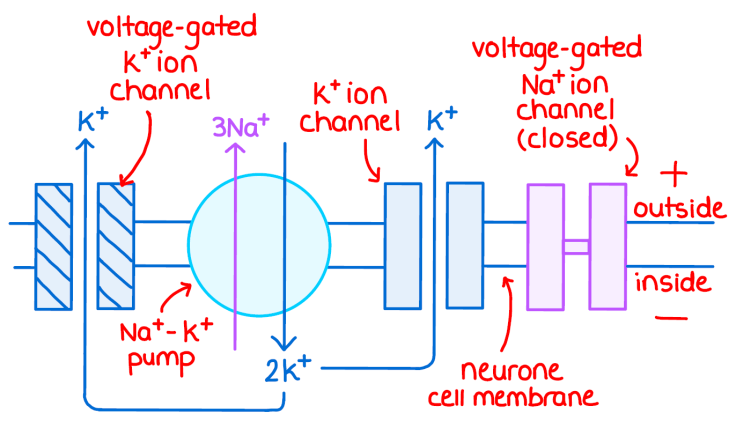
- Resting potential – the Na+-K+ pump returns the membrane potential to -70mV by actively transporting both ions across the membrane.
Repolarisation and hyperpolarisation together make up the refractory period when the membrane is not able to produce another action potential as the Na+ channels are inactivated. This is one mechanism to keep the nerve impulse travelling in one direction – more on that here.
Summary
- There are four stages to an action potential: depolarisation, repolarisation, hyperpolarisation, and return to resting potential.
- Voltage-gated ion channels open and close to control diffusion of Na+ and K+ ions across the neurone membrane, which drives changes in potential difference.


