Natural selection is one way that evolution occurs. Evolution is the change in allele frequencies over time. In this article we will look at the process of natural selection, and a few different types of selection. Note that there can be other mechanisms behind evolution as well, such as genetic drift described here.
Natural selection
The process of natural selection is quite simple:
- Random mutations result in new alleles being formed.
- An advantageous allele means that an individual is better adapted to survive the selection pressures in its environment.
- The individual is more likely to survive to reproduce and pass on the advantageous allele to its offspring.
- Over many generations the advantageous allele frequency increases in the population.
A selection pressure is something in the environment which affects the chances of an organism surviving to reproduce. It could be predation, competition, an extreme environment (e.g. very cold), or disease etc.
Remember that alleles are different versions of a gene.
Directional selection
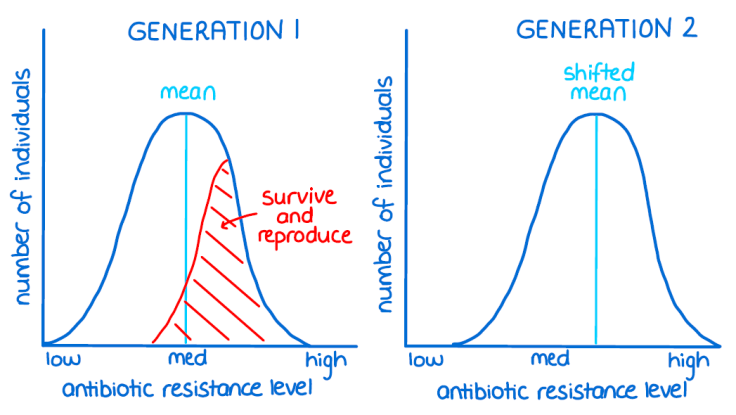
Directional selection happens when it is advantageous to have an extreme phenotype. For example (the AQA example), bacteria can have a range of antibiotic resistance capabilities. In an environment where any antibiotic is present, the bacteria with a higher levels of antibiotic resistance are more likely to survive and reproduce. The advantageous alleles are passed onto their offspring, and in the next generation the mean is shifted to a higher level of antibiotic resistance. (Remember that bacteria don’t have two parents – they divide by binary fission.)
Stabilising selection
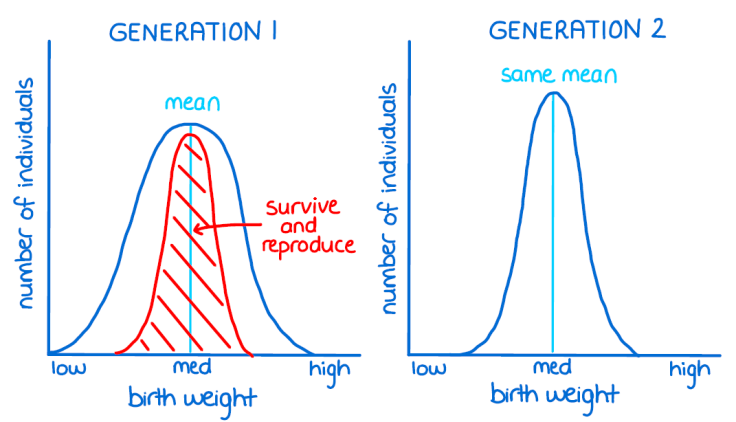
Stabilising selection is where the range of phenotypes in a population is reduced due to selection pressures. A good example of this (needed for AQA A-Level biology) is birth weight in humans. If a baby is very light or heavy at birth, it has lower survival chances than a baby with an average birth weight. This means that the “breeding population” of humans have birth weights nearer the mean and will pass on those alleles to their offspring. The range of birth weights in the next generation will be reduced around the same mean.
Disruptive selection
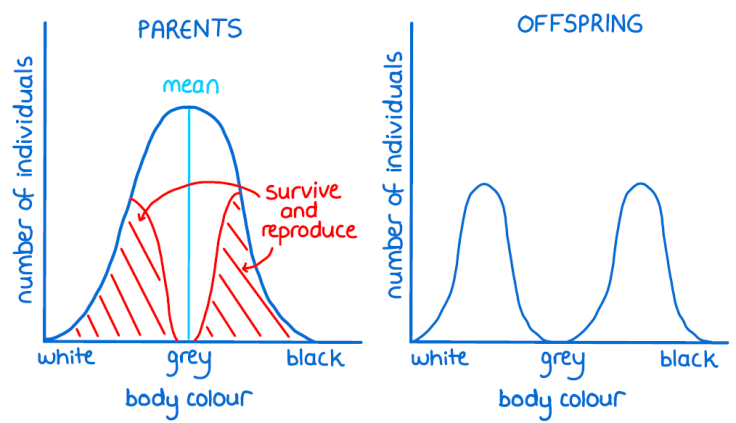
Disruptive selection is where phenotypes at either extreme can be an advantage. For this, I’m going to make up an example vaguely based on the peppered moths (find out more about them here). Say there was a habitat with very light areas and very dark areas. If an animal lived in that habitat, it would be advantageous for it to be white or black because they would be camouflaged from predators in one type of area. However, if the animal was grey, it wouldn’t be camouflaged in either of the areas so would be more likely to be killed by a predator. So the breeding populations would be at either extreme. The offspring would have fewer alleles coding for the grey colour, but more alleles coding for the white or black colour. The population gets divided, and this could eventually result in sympatric speciation.
Summary
- Natural selection is a mechanism which drives evolution – the change in allele frequencies over time.
- Random mutations form new alleles. If the alleles are advantageous, individuals which have those alleles are more likely to survive and reproduce.
- Directional selection, stabilising selection, and disruptive selection are all types of selection.