The nervous system communicates information by propagating nerve impulses. In the last article we saw how impulses are generated at receptors in response to a stimulus. Now the impulses must be transmitted by neurones. In this article we will look at some of the different types of neurones found in the nervous system, and see how the neurone cell-surface membranes are polarised at rest.
Sensory neurones
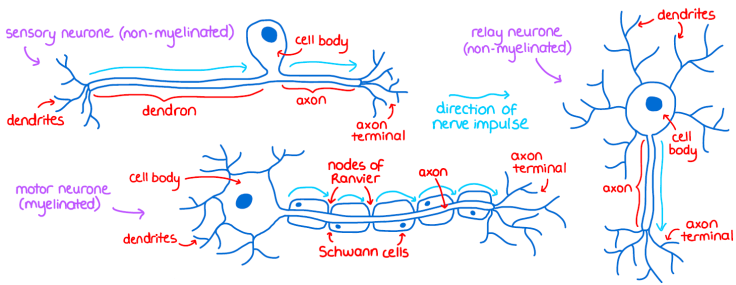
Sensory neurones transmit nerve impulses from receptors to the central nervous system (CNS). They connect to receptors using short dendrites, and the impulse is transmitted towards the cell body along the dendron. The cell body contains the nucleus and other organelles. The impulse is then transmitted away from the cell body along a short axon to the axon terminal.
Relay neurones
Relay neurones quite literally relay the nerve impulse between a sensory neurone and a motor neurone. They are found in the CNS. The many dendrites branching off the cell body connect to the axon terminals of sensory neurones via synapses (another article!). The impulse is transmitted along the axon to the axon terminal.
Motor neurones
Motor neurones transmit nerve impulses from the CNS to an effector (e.g. a muscle or gland) which will bring about the response. The cell body is found at the start of the neurone and has many short dendrites branching off it to receive impulses from relay neurones. It has one long axon ending in the axon terminal, which connects to the effector.
Resting potential
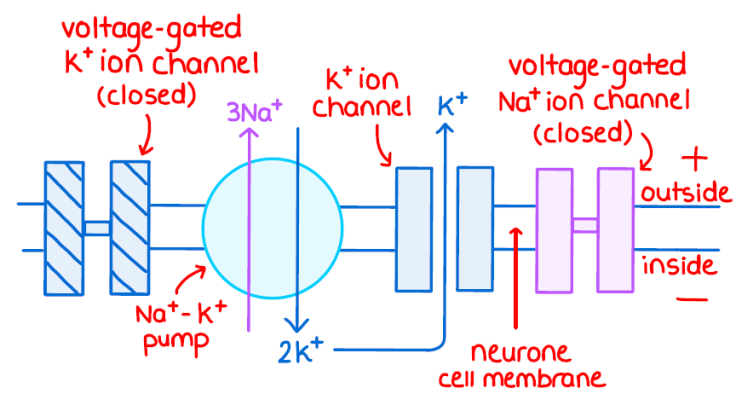
When a neurone is not stimulated the membrane is polarised, which means that the outside of the cell is more positively charged than the inside. This is due to the movement of positive ions across the membrane. Sodium (Na+) ions are pumped out of the neurone by active transport using sodium-potassium pumps. The Na+ ions cannot diffuse back into the neurone because the voltage-gated sodium ion channel proteins are closed, so an electrochemical gradient of sodium ions is maintained. However, the potassium (K+) ions which are pumped into the neurone (also by active transport using the sodium-potassium pump) are able to diffuse back out of the neurone through potassium ion channel proteins (facilitated diffusion) down the electrochemical gradient. We say that the membrane is more permeable to K+ ions than Na+ ions when in the resting state. During action potential that all changes – we will take a look at action potential in the next article. The potential difference across the neurone cell-surface membrane during at resting potential is -70mV.
Summary
- Sensory neurones transmit nerve impulses from receptors to the CNS.
- Relay neurones are found in the central nervous system.
- Motor neurones transmit nerve impulses from the CNS to effectors.
- Resting potential is maintained by active transport of sodium and potassium ions, and a difference in membrane permeability to sodium and potassium ions. The potential difference across the cell membrane is -70mV.