We know that nerve impulses are transmitted along neurones in a wave of depolarisation. But how does a nerve impulse get transmitted from one neurone to the next? Well, that is where synapses come in.
Structure of synapses
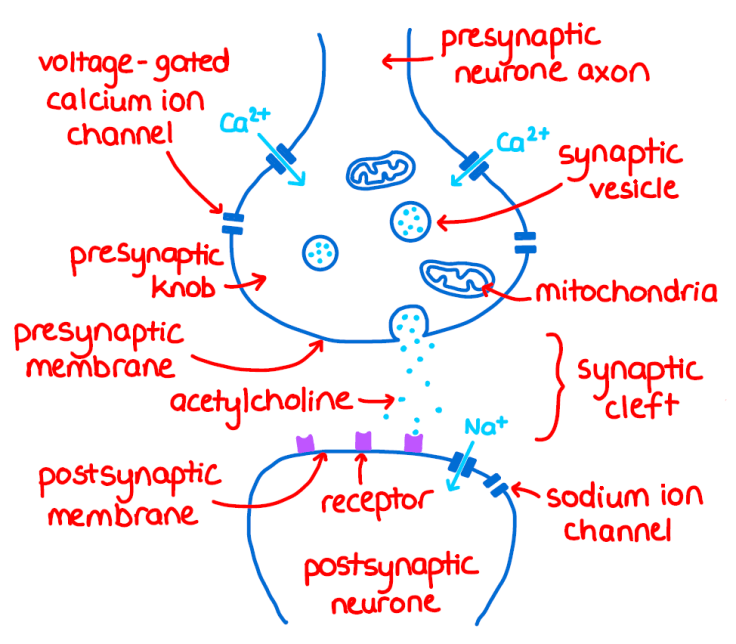
Synapses are the microscopic gaps between neurones. The neurone before the synapse is called the presynaptic neurone, and has a rounded end called the presynaptic knob. This contains synaptic vesicles filled with neurotransmitters. These are chemicals which convey the message across the synaptic cleft (the gap). The neurone after the synapse is called the postsynaptic neurone. Receptors that are complementary to the neurotransmitter are embedded in the postsynaptic membrane.
Transmission of nerve impulses across cholinergic synapses
A cholinergic synapse is a type of synapse that uses acetylcholine as the neurotransmitter. The nerve impulse is transmitted across it as follows:
- An action potential arrives at the synaptic knob which stimulates voltage-gated calcium (Ca2+) ion channels to open in the presynaptic neurone membrane.
- Ca2+ ions diffuse into the synaptic knob through the open ion channels which triggers the synaptic vesicles to move towards the presynaptic membrane.
- The vesicles fuse with the membrane and release acetylcholine (the neurotransmitter) into the synaptic cleft. This is an example of exocytosis.
- Acetylcholine diffuses across the synaptic cleft and binds to acetylcholine receptors on the postsynaptic membrane.
- Sodium (Na+) ion channels open in the postsynaptic membrane and Na+ ions diffuse into the neurone. If threshold is reached, the membrane depolarises and the action potential continues.
- Acetylcholine is broken down by acetylcholinesterase in the synaptic cleft, and the products of the reaction are taken back up into the presynaptic neurone so that acetylcholine can be resynthesised.
Summary
- Synapses are junctions between neurones.
- Facilitated diffusion of calcium ions into the presynaptic knob triggers synaptic vesicles to release the neurotransmitter into the synaptic cleft.
- Neurotransmitters bind to specific receptors on the postsynaptic membrane.