Antibodies are very important proteins in the immune response. We’ve already mentioned them a lot in the last few articles, but here we will take a detailed look at their structure and function, and how they can be used in medical applications.
Antibody structure
Antibodies are proteins with a quaternary structure. They have two longer polypeptide chains called the heavy chains, and two shorter polypeptide chains called the light chains. The four polypeptides are held together with disulfide bridges. Most regions of the polypeptides are the same across all antibodies, but there are variable regions which have a specific tertiary structure, making them specific to one antigen. There are two of these regions, meaning that one antibody can bind to two of the same antigen (important for agglutination below). When an antibody binds to a complementary antigen it forms an antigen-antibody complex (much like an enzyme-substrate complex).

You may often hear the term monoclonal antibodies. This just means antibodies which are all identical to each other and are specific to one antigen. Antibodies can either be membrane-bound (bound to the cell-surface membrane of B-cells) or secreted by plasma cells.
Antibodies in the immune response
We’ve already taken a detailed look at the immune response here, and learnt that plasma cells produce many antibodies which are complementary to the foreign antigen. But how do antibodies actually help pathogens to be destroyed?

- Agglutination: because antibodies can bind to two antigens at once, they can clump pathogens together (seen in the diagram). Phagocytes can then engulf whole clumps of pathogens at once which makes phagocytosis more effective.
- Block the antigens on the pathogen from binding to host cells.
- Antibodies called antitoxins can neutralise toxins by binding to them.
Bear in mind that antibodies do not destroy pathogens – the phagocytes do that. Antibodies just make this process more effective.
Pregnancy testing
Pregnancy testing is a nice little example of how monoclonal antibodies can be used medically. When women are pregnant, are hormone called human chorionic gonadotropin (hCG) can be found in their urine. Antibodies which bind to hCG are used in the pregnancy test.
- The area where the urine is applied contains coloured beads attached to monoclonal antibodies specific to hCG. Any hCG in the urine binds to the antibodies.
- The urine travels along the stick, bringing the coloured beads and antibodies with it.
- In the result window, there are more monoclonal antibodies specific to hCG, but they are immobilised (stuck down). If hCG is bound to the antibodies on the coloured beads, hCG will also bind to the immobilised antibodies, which traps many of the coloured beads in the result window and it changes colour (turns blue). The result is positive.
- If no hCG is present in the urine, the urine will just travel all the way along the strip bringing the coloured beads with it. There will be no binding in the result window, so it does not change colour. Instead, all the coloured beads end up in the control window, where there are some antibodies that are complementary to the hCG antibodies.

ELISA tests
ELISA stands for enzyme-linked immunosorbent assay. They are really useful tests that have all sorts of applications, but in medicine they can be used to see if a patient has certain antibodies in their blood. Let’s use the example of testing to see if someone has antibodies for SARS-CoV-2 (the virus that causes Covid-19), as that is a recent use for the ELISA test.
- The SARS-CoV-2 antigen is provided bound to the bottom of a well in a well plate. The patient’s blood plasma is added to the well.
- If the plasma contains antibodies which are complementary to the SARS-CoV-2 antigen, they will bind to the antigen. All other types of antibodies in the plasma will not bind to anything.
- The well is washed out to remove all unbound antibodies.
- A secondary antibody is added to the well. The secondary antibody is designed to be complementary to the SARS-CoV-2 antibody, and also has an enzyme attached to it. So the secondary antibody will only bind if the SARS-CoV-2 antibody had bound to the antigen in step 2.
- The well is washed out again to remove all unbound secondary antibodies.
- The substrate for the enzyme is added. Therefore, if the SARS-CoV-2 antibody is bound to the antigen, and the secondary antibody is bound to the SARS-CoV-2 antibody, the enzyme catalyses a reaction which creates a colour change. This is then detected as a positive result.
- If there is no colour change, it is a negative result and the patient does not have SARS-CoV-2 specific antibodies in their blood.
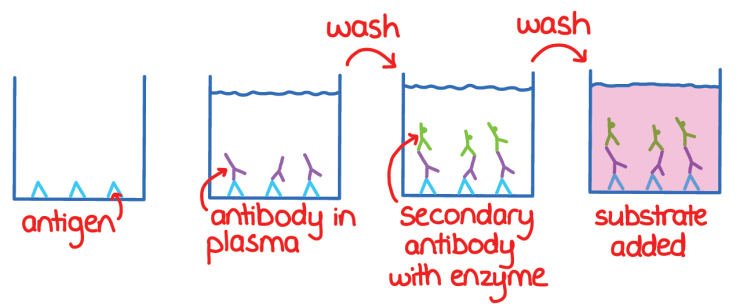
The type of ELISA test shown here is an indirect ELISA because it uses two antibodies. You can also get direct ELISAs which just use one antibody, but indirect ELISAs are generally more sensitive even though they take a bit longer. Indirect ELISA tests can be used in a similar way to test for HIV-specific antibodies.
Targeting specific cells
All cell types in an individual have specific cell-surface antigens which identify them. If a cancerous tumour develops in a tissue, the cancer cells will have different antigens to the surrounding normal tissue cells. This is very useful because it means they can be targeted by monoclonal antibodies. An anti-cancer drug could be attached to an antibody which is specific to the cancer cell antigens (called tumour markers), so the drug is only delivered to areas where the cancer cells are growing. This decreases side-effects of the drug.
Summary
We have covered a lot about antibodies in this article. They are extremely useful molecules which have all sorts of applications – even more than listed in this article!
- Antibodies are proteins with variable regions which make them specific to an antigen.
- They help pathogens to be destroyed by phagocytes more efficiently by causing agglutination.
- Monoclonal antibodies have medical applications in pregnancy testing, ELISA tests for diagnosis, and targeting drug delivery to a specific cell type.