So far in the genetic engineering journey we have learnt how to isolate or produce a DNA fragment, and amplify it in vitro using PCR. Transforming bacteria is a method to amplify a DNA fragment in vivo (in a living organism), and to engineer bacteria to produce a protein. In this article we will look at the steps involved in this process.
Inserting a DNA fragment into a vector
A vector is something used to transfer DNA into another cell. Often a vector is a plasmid (a small circle of DNA) which is what we will use as an example in this article. Another type of vector is a bacteriophage – a virus which can infect bacteria and therefore inject the DNA fragment into the bacteria.
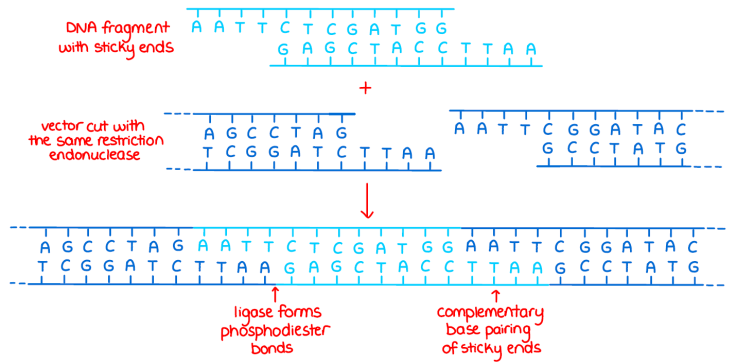
To insert a DNA fragment into a plasmid, we need our old friends the restriction endonucleases. The vector is cut open using the same restriction endonuclease that was used to isolate the DNA fragment, so the exposed bases in the sticky ends will be complementary to each other. The sticky ends on the DNA fragment and plasmid will join with complementary base pairing, then the enzyme DNA ligase is added to join the sugar-phosphate backbones with phosphodiester bonds. Recombinant DNA has been formed, because the DNA is now a combination of the DNA fragment and the plasmid vector.
Transforming bacteria
The plasmid vector must now be taken up by bacterial cells. However, bacteria will not take up the plasmid unless the permeability of the cell-surface membrane is increased. There are two methods to do this:
- Electroporation: a brief high-voltage electric pulse is passed through a solution containing the bacteria and plasmid.
- Heat-shock: a solution containing the bacteria and plasmid is placed on ice then transferred to 42°C for about a minute.
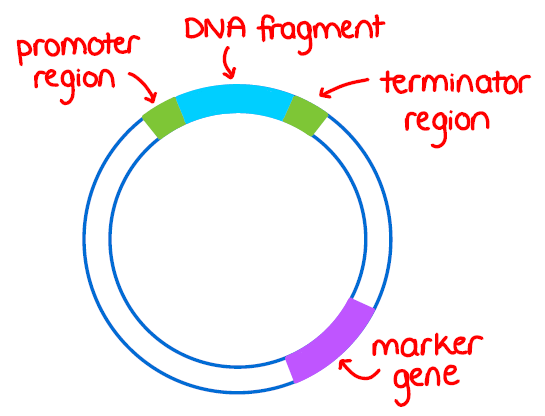
The plasmid will now have entered some of the bacterial cells, but not all of them. So the next step is to identify which bacteria contain the plasmid. To enable this, the plasmid is designed to contain a marker gene. This marker gene often codes for antibiotic resistance, but could also code for fluorescence. Note that plasmids will also have a promoter region and terminator region which allow the DNA fragment to be expressed in bacterial cells (see next section).

The bacteria are spread onto an agar plate containing an antibiotic. Each individual bacterial cell will divide by binary fission and produce a little colony. However, only bacteria which contain the antibiotic resistance marker gene will be able to survive and divide, so any bacteria which did not take up the plasmid will be destroyed. A colony of transformed cells can now be cultured further until there are a huge number of bacteria containing the plasmid.

Producing a protein
Often when doing genetic engineering you want the transformed cells to transcribe and translate the DNA fragment to produce the protein. In order for this to work, the plasmid must contain a promoter region before the DNA fragment and a terminator region after the fragment. The promoter region acts as the “start here” flag to tell RNA polymerase that it must bind to the DNA and start transcribing at that point. The terminator region acts as the stop signal to tell RNA polymerase to stop transcription. Sometimes the promoter can also be used to control expression, and the fragment will only be transcribed if something specific is present e.g. a certain transcription factor. This enables expression of the DNA fragment to be altered by the scientist as required.
Summary
- A DNA fragment is inserted into a vector using a restriction endonuclease and DNA ligase.
- Electroporation or heat-shock enable the bacteria to become transformed and take up a plasmid vector.
- A marker gene allows for selection of successfully transformed bacterial colonies.
- Promoter and terminator regions in the vector allow transcription of the DNA fragment.